History of Sarawak Cultural Village


To see Sarawak in one sunny day .. this is the basic concept of Sarawak Cultural Village, where the 48,000 square miles of Malaysia's most majestic State are condensed into just 17 acres. One leisurely stroll opens seven homes to the visitor, seven cultures, including the famous longhouses of Borneo.
Ever since tourism took its first hesitant steps into Sarawak in the 1960s, the intrepid 'adventurers' who veered off the beaten track found Borneo's unique house-form an irresistible attraction. Of course they wanted to see the landscape of breathtaking splendour and the world's richest ecosystem, but the fascinating array of peoples and cultures was the real magnet. Unfortunately, Sarawak is huge, much of it covered by rugged mountains and jungle. How can a visitor hope to sample it all in less than three weeks of arduous travel?

A few far-sighted planners suggested that we build a 'model' village or longhouse within easy reach of Kuching. In the 1970s, cultural performances in a langkau in the Museum Gardens scored a spectacular success. This reactivated the idea; the Reservoir Park was suggested as a possible site, so was Sungai China in Matang. The Sarawak Museum contributed ethnographic and cultural input... but nothing came of it. There were other development priorities.

The plan for a Cultural Village was resuscitated in the 1980s, after the whole Damai area had been identified as a 'tourism zone'. Architects and engineers engaged in the early stages of the project cruised up and down the river in the time-honoured Sarawak way - Santubong Bridge didn't link the road from Kuching to the sea until 1988. The very road to and from the bridge and around the steep flank of Mt.Santubong had to be built first!

But build it they did - SCV took shape with a Bidayuh, Iban, Orang Ulu and Melanau longhouse, a Penan hut and a Malay village house, and a Chinese farm house. By mid-1989 a solemn house-warming ceremony with offerings and sacrifice put life into the empty wooden structures. The dream had become reality.


1. Bidayuh Longhouse 5. Melanau Tall House
2. Iban Longhouse 6. Malay House
3. Penan Hut 7. Chinese Farmhouse
4. Orang Ulu Long House


The Food YOU Must Try


Food in Sarawak is abundant. Due to the fact that it is made up of a multi-cultural and ethnical environment, one could expect a lot of specialized dishes while a fusion of the various cuisine can also be found.
Typically, Sarawak food is known to be spicy. The chillies and pepper here are known to be more aromatic and provides more kick for the spicy food lover as compared to other parts of the country. The Sarawak Laksa for example is one of the famous exports from the state. It can be found in almost any food outlet in around here. Although there has been ‘imports’ in other states, nothing beats trying the most authentic and traditional noodles cooked with santan gravy of curry and meat at its best. The Umai is made up of raw fish in chilly sauce a very home cooked traditional Melanau cuisine. The Tomato Kuey Tiaw is typically fried keuy tiaw made famous by the people of Penang. The local variation here is cooked with chicken meat in tomato gravy and seafood found mostly in around the capital city. In terms of noodles, one must try the Kolo Mee. This to some is some sort of a Hakka dish, where similar to Wantan Mee, does not use the thick soya sauce for cooking. Normally uses dry egg noodles, it is an authentic Sarawakian dish served with barbecue pork, minced meat and vegetables. The Bario Rice is also one of the attractions that one should try. Planted in the Bario Highlands, the rice is known to be smaller as compared to other types of rice and is cooked in various ways. The normal dish accompanying serving and those that are wrapped in leaves that is like the ketupat. A definite must-try. The Sarawak Layer Cake or in local terms known as Kek Lapis Sarawak is also one the more popular snacks apart from the Miri Rojak and Cendol.

One should also try out the Tuak, a type of rice wine locally produced and the Langkau which is a type of Iban Longhouse produced whisky, strong alchoholic drinks that is enjoyed by the locals and a must try for visitors.


SARAWAK LAKSA


SARAWAK UMAI


SARAWAK TOMATO KUEY TIAW


SARAWAK KOLO MEE


SARAWAK LAYER CAKE


MIRI ROJAK


SARAWAK CENDOL


SARAWAK TUAK


The villager served the tourist a cup of TUAK.

Tourist Attraction of Sarawak Cultural Village


Sarawak Cultural Village is the window to the culture and heritage of Sarawak.

<----Sarawak Cultural Village Map

There has 6 main spot in the Sarawak Cultural Village:
-Chinese Long House
-Melayu Long House
-Melanau Tall House
-Orang Ulu Long House
-Iban Long House
-Bidayuh Long House


Entrance Fee
RM45.00 for Adult
RM22.50 for Children (6-12years old)
Free for Children aged under 6
Ticket are available at the Entrance of the Village
Opening Hours : 0900-1715 daily

There are two Cultural Shows per day. Catch them at:
1130-1215
1630-1715


The man-made lake at the Sarawak Cultural Village


Chinese Long House


The cultural showcase in this village presents a typical Chinese farmhouse. The house is built on ground level unlike most tribal houses in Sarawak which are built on raised platforms some metres above ground.

There are two main divisions in the farmhouse - the communal living area which has the kitchen, dining tables and storage space for personal belongings, as well as the bedroom. The communal area also features an important shrine where the house residents will offer their daily prayers.

The village personnel attending the house can also demonstrate a few traditional methods on processing bird's nests, grinding black peppers, making Chinese tea, assembling Chinese brooches, and sculpting clay potteries. In fact, right outside the farmhouse, there is a traditional furnace used to bake the potteries into the hardened stoneware we commonly seen in souvenir stores.


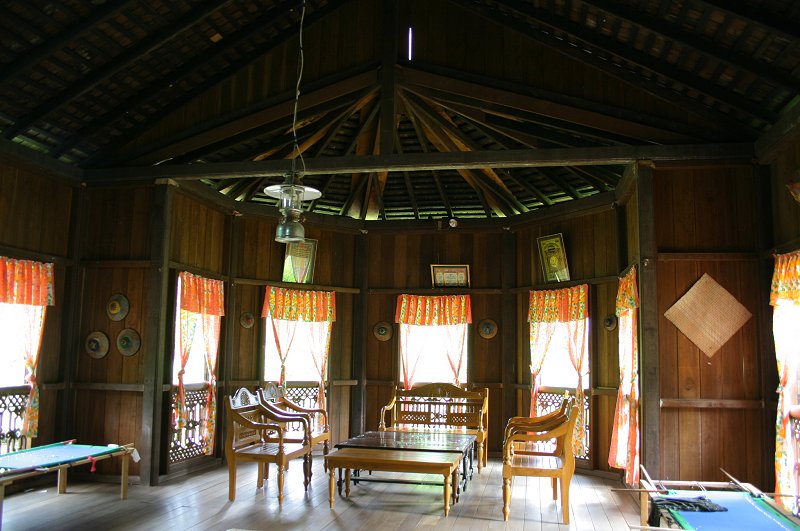
Melayu Town House


The showcase house is taken out from a typical home design of traditional Malay villages commonly found in parts of Sarawak and most parts of Peninsula Malaysia. The house is built on stilts some metres above ground.

It is customary practice to open your shoes at the veranda prior to entering a Malay house. At the communal living area, village personnel were seen playing with a traditional game of congkak while chit-chatting about their daily life. After the bedroom area, you can see the kitchen area with cooking utensils and dining tables.

Outside the house compound is a special pavilion where top spinning sessions are occasionally demonstrated to the public.


Melanau Tall House


Visitors will be amazed when first seeing the Melanau Tall House in the cultural village. It is built some 40 feet above ground that you will wonder how these tribal people, isolated from common modernity, were able to build such a behemoth. In as much as the house itself being an engineering marvel of its own, there are reasons why the house is built in such way.

There are staircases provided for visitors to enter the tall house. The first staircase will bring you to the first floor where the display of tools and utensils associated with ethnic Melanau is available througout. Surprisingly, there is another staircase made of tree trunks to the second floor where the bedroom models are showcased. Climbing these trunk-staircase is an acquired skill on its own and caution should be exercised.

You can also get the chance to sneak a taste of a local sweet delicacy called kuih tebaloi. This novelty item can also be purchased at the outlet for RM3 per pack.


Orang Ulu Long House


The Orang Ulu Long House is the most impressive of all the showcase houses when it comes to appearance. The house is built on raised floors some feet above ground amidst lush tropical greenery. In fact, on first glance, you can mistake the long house as being an exquisite and luxurious jungle resort with its open-air veranda, superb traditional motifs painted on the totem poles, artistically-rich equipment and tools etc.

The house also features the most colourfully-dressed ladies that you can find throughout the village. Occasionally, the ladies will perform a welcoming dance at the main veranda while the visitors are being serenaded by the beautiful tunes from the traditional wooden xylophone called Jatung Lutang.

Outside the long house is a small hut where metal swords are fabricated. The process, requiring adept skills and profound craftsmanship, is a dying art and should not be missed altogether.


Iban Long House


The Iban House bears close resemblance to the Bidayuh House. The long house is built of local timbers tied together with naturally-harvested fibre woods. Since the real Iban long houses are often erected near the major rivers of Sarawak, the design emulates a raised floor concept to ensure the occasional surge of river flow will not enter the long house.

In the front yard of the long house is an open-air communal area where you can meet Iban ladies in colourful traditional dresses, as well as the much revered elders of the long house.


Bidayuh Long House


At the main entrance, one will enter a pavilion-like circular structure made of mostly bamboos. This structure, connected to the long house by a wooden plank, is known as Baruk which functions as the congregation place for the Bidayuh warriors. The Baruk's interior is filled with weapons, gongs, wooden masks and other personal effects. There is a raised platform right in the middle of the Baruk. If you look straight up from the platform, you will see human skulls hung from the roof top. According to the lady inside the Baruk, those human skulls are real and they were once the enemies killed by Bidayuh warriors.

The long house is actually pretty decent. The internals are quite similar to other long houses you can find in the cultural village, with the exception of an open-top sprawling veranda made of bamboo floors which I thought was quite nice.


The Sarawakian


This is where the many different tribes come together for a cultural show. And it is here that one can see the different costumes of all them, and to further understand the many races living in harmonious Sarawak.

I've been informed that there are close to 40 different tribes/ races in Sarawak. Maybe being a lil ignorant... for I didn't know that the major race in Sarawak is actually the Ibans, followed by the Chinese.

So coming to this village sure was good, as I now understand the multi racial aspects of East Malaysia, especially Sarawak better.

No wonder, there is the saying that East Malaysia is so multi racial - way more than what we experience in West Malaysia! I agree on this.
And I also think that this leads to the good thing about Sarawak - where everyone seems to bond so much better & are so friendly - be it from Kuching city or the outskirts... relating very closely to the tagline we have - 'the Malaysian warmth & Malaysian smile'... I personally think it's all here in Kuching - from my experience, at least! :)

The link of the sarawak cultural

WELCOME TO SARAWAK


target audiences

target audience range: all people

children/teenagers: more and more younger neglect the cultural, so we hope that we can use this blog to let them more understanding to the cultural of Malaysia.

Adult : Most of the Adult have the financial ability, so that they will spend more and visit the Sarawak, stimulate the economic of the Sarawak effectively.

Objective

The objective of our blog:
  1. Promoting the cultural of the state effective
  2. Attracting more visitor to the Sarawak.
  3. Improving the cultural of the Sarawak.
  4. Let the visitors more understanding to the cultural of the Sarawak.